

People who walk past the tea tree bed at the farm usually make the same gesture: they pick a sprig, rub it between their fingers and bring it to their nose. The smell is fresh, a little medicinal, somewhat earthy, somewhat camphor-like. It's an aroma many people recognize without knowing where from, because melaleuca, better known in English as tea tree, is today one of the most used and most studied essential oils in the world. This article tells where it comes from, what the analysis of our oil shows and how to use the essential oil and the hydrosol safely.
Where tea tree comes from
Melaleuca alternifolia is a small tree in the myrtle family, the same family as eucalyptus, clove and guava. It is native to eastern Australia, mainly northern New South Wales and southern Queensland, where it grows wild in wetlands, along riverbanks and in swampy ground. Its leaves are needle-thin, soft to the touch, and hold the oil in tiny glands that burst when crushed.
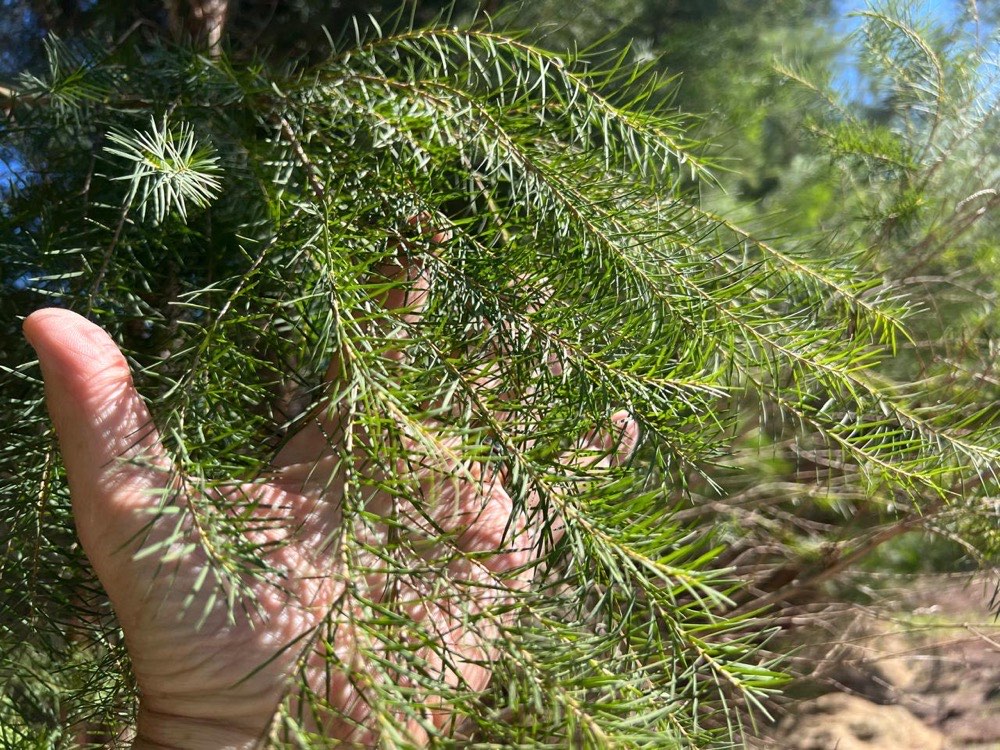 A hand holding a sprig of tea tree, showing its thin, elongated, needle-like leaves
Long before any laboratory, the Aboriginal peoples of the region, especially the Bundjalung, were already using the plant. They crushed the leaves and applied them as a poultice to cuts, burns and insect bites, and inhaled the aroma of the crushed leaves to ease breathing. Oral tradition speaks of "healing" lagoons, where leaves fallen from the trees turned the water dark and fragrant.
The English name, tea tree, dates from the 18th century: the story goes that sailors on Captain James Cook's expedition used the leaves of similar trees to brew a drink that stood in for tea. The name stuck, even though tea tree has nothing to do with the plant that gives us green or black tea.
Science arrived only in the 1920s, when Australian chemist Arthur Penfold published studies showing that the oil had a germicidal action far stronger than phenol, the reference antiseptic at the time. During World War II, tea tree oil was part of the first-aid kits of Australian soldiers fighting in the tropics, and its producers were even exempted from military service to keep the supply going. With the arrival of antibiotics it lost ground, and only came back strongly from the 1970s, when interest in natural alternatives and the problem of bacterial resistance brought the plant back into the labs.
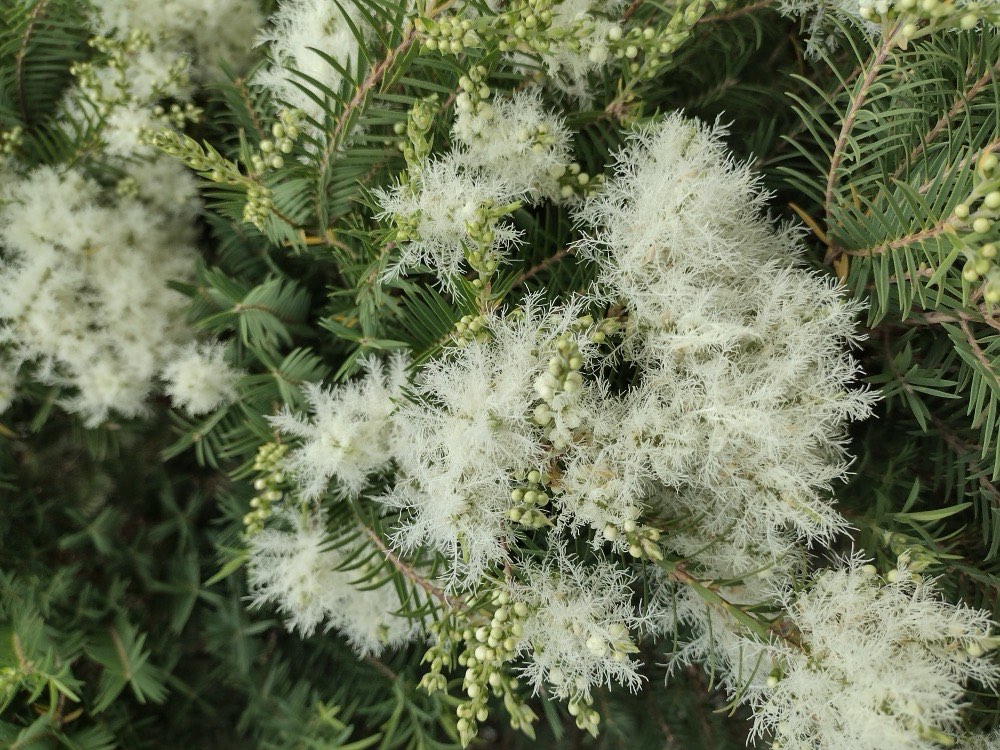 The fluffy white flowers of tea tree, in clusters, among the plant's thin leaves
Here at the farm, tea tree has adapted well to the climate and grows in tall rows. The leaves and thin branches are harvested and taken straight to the distillery, where they go through steam distillation.
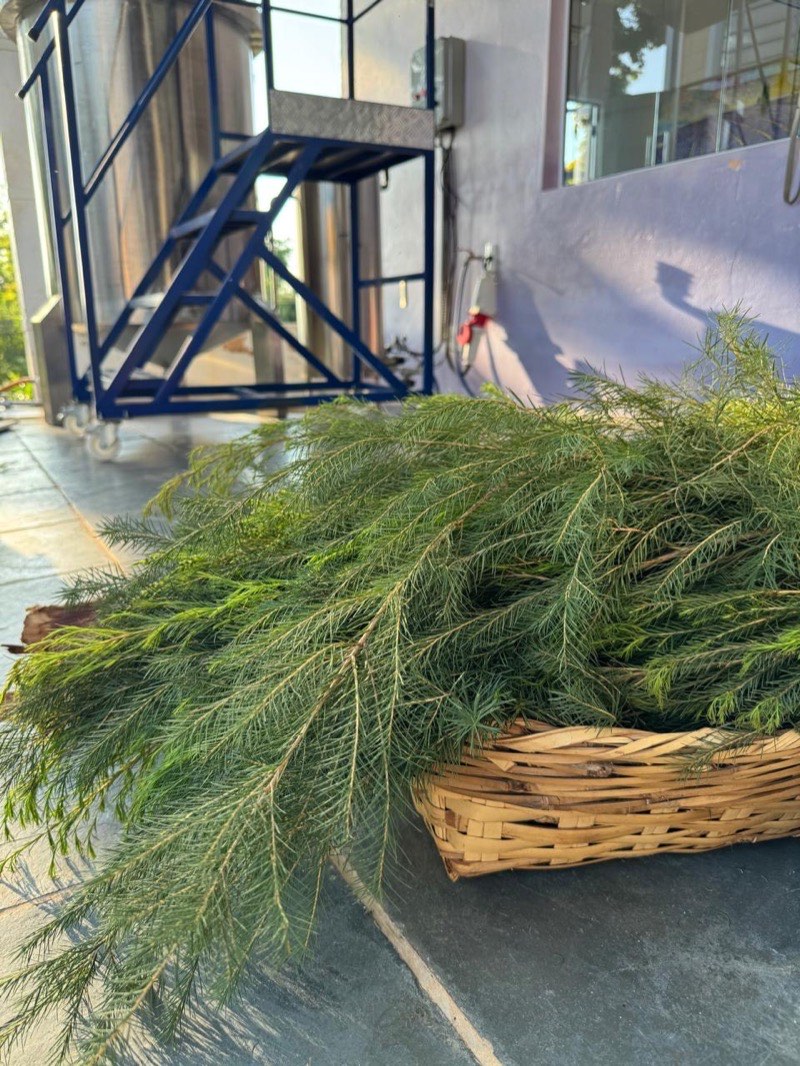 A wicker basket full of fresh tea tree branches next to the distillery boiler, ready for distillation
What the chromatography shows
An essential oil is not a single substance: it is a mixture of dozens of compounds, and the proportions between them change with the plant, the soil, the climate and the distillation. That's why we have our oil analyzed by gas chromatography–mass spectrometry (GC-MS), a test that separates and identifies each component. The report for our tea tree oil shows 26 compounds, 22 of them identified by name. The main ones are:
| Compound | % in our oil | What is known about it |
|---|---|---|
| Gamma-terpinene | 29.27% | A monoterpene with antioxidant action; contributes to the antimicrobial activity of the whole |
| Terpinen-4-ol | 28.94% | The "heart" of tea tree: mainly responsible for its antibacterial, antifungal and anti-inflammatory action |
| Alpha-terpinene | 12.77% | Antioxidant; it is also the compound that oxidizes most over time, which is why the oil needs to be stored well |
| Terpinolene | 4.10% | Fresh, woody aroma; antimicrobial and antioxidant activity |
| Alpha-pinene | 3.10% | Common in conifers, associated with a "forest" aroma and a mild bronchodilating effect |
| Para-cymene | 2.51% | Present in small amounts in fresh oil; increases as the oil ages |
| Alpha-terpineol | 2.21% | An alcohol with antimicrobial action that reinforces that of terpinen-4-ol |
| Viridiflorene | 2.20% | A sesquiterpene that gives depth to the aroma |
| 1,8-cineole (eucalyptol) | 1.90% | The "eucalyptus" compound; low here, which makes the oil less irritating to the skin |
| Delta-cadinene and aromadendrene | 1.80% and 1.79% | Sesquiterpenes with antimicrobial activity described in the lab |
Terpinen-4-ol is the most studied compound. Research at the University of Western Australia showed that it damages the membrane of bacteria and fungi, making the cell lose its contents and die, and that it also reduces the production of inflammatory substances by the body's defense cells. That is why tea tree shows up as both antiseptic and soothing for the skin. The terpinenes (gamma and alpha) complete the picture with significant antioxidant action.
Another point the report shows is the low 1,8-cineole content. In high amounts, this compound makes the oil more irritating to the skin, and international quality standards for tea tree oil limit how much of it may be present. In our oil, it stays below 2%.
The full report, with the chromatogram and the table of every substance, is published on the lab reports page.
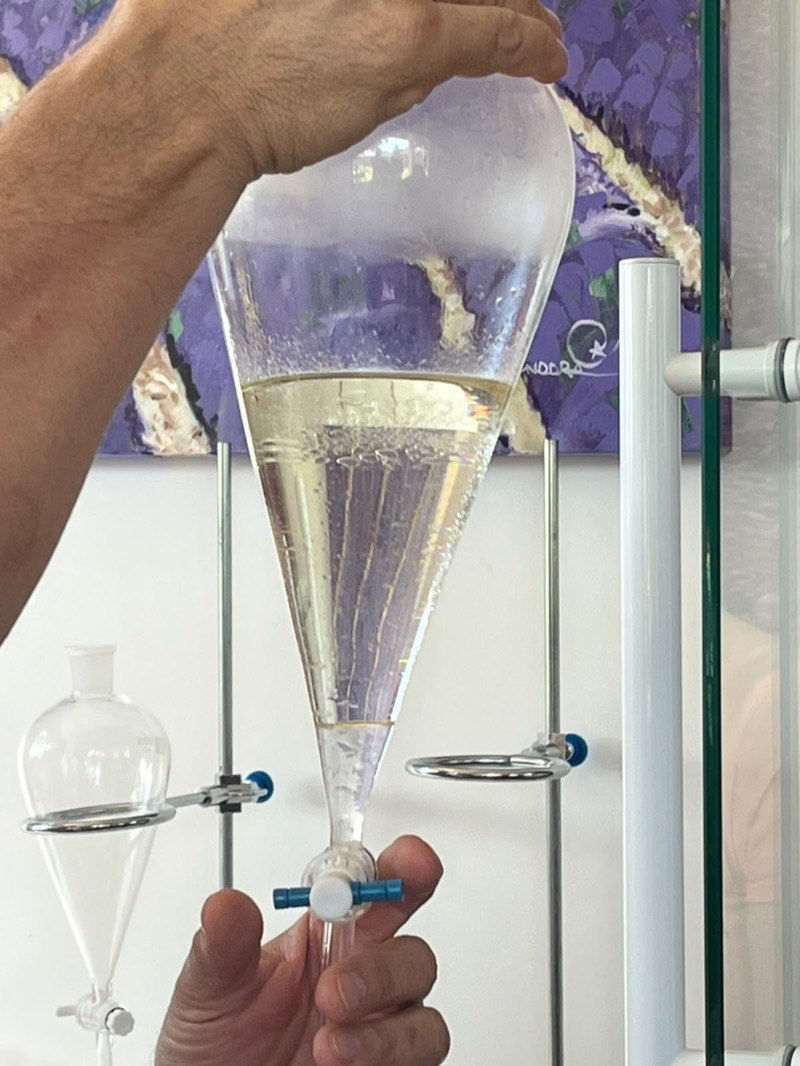 A glass separating funnel with the tea tree distillate, where the essential oil and the hydrosol separate into layers
Essential oil and hydrosol: two fractions of the same plant
Distilling tea tree yields two products at the same time. The essential oil concentrates the fat-soluble substances: it carries the terpinenes, terpinen-4-ol and the sesquiterpenes in the proportions shown above. The hydrosol concentrates the water-soluble substances, and so it has a different profile: the more "oily" compounds, such as the terpinenes, barely pass into the water, while aromatic alcohols such as terpinen-4-ol and alpha-terpineol dissolve better in it. The result is a gentle product, with a pH close to the skin's, that keeps the aroma and much of the plant's character without the concentration of the oil.
If you'd like to understand this difference better, we wrote an article just about it: essential oil or hydrosol, what is the difference.
Physical properties
The properties attributed to tea tree, both by tradition and by research, revolve around a few themes:
- Antibacterial and antiseptic. In the lab, it acts against a wide range of bacteria, including Staphylococcus aureus, common in skin infections.
- Antifungal. It acts on fungi such as those of the Candida genus and those that cause skin fungal infections and athlete's foot.
- Antiviral. There are lab studies with viruses such as the cold sore virus, still without robust clinical confirmation.
- Anti-inflammatory. Through terpinen-4-ol, it helps calm skin redness and swelling.
- Expectorant and decongestant, by inhalation, traditionally used for flu, colds, coughs and sinusitis.
It's important to separate lab effects from what has been confirmed in people. The most consistent clinical studies concern use on the skin: a gel with 5% tea tree oil reduced mild to moderate acne lesions, working more slowly than benzoyl peroxide but with less dryness and peeling; a 5% shampoo improved dandruff; and there are positive, if modest, results against athlete's foot. The US National Center for Complementary and Integrative Health (NCCIH) sums it up well: there are signs of benefit, mainly for acne, but larger studies are still needed for firm conclusions.
Emotional properties
Tea tree has a curious way of growing: its trunk sheds its own layers like sheets of paper, and a new bark forms underneath. It renews itself from the inside out, in a continuous cycle of cleansing. In aromatherapy, this image helps explain what the plant offers emotionally: renewal, purification and letting go of what no longer serves us, of what weighs us down and pulls us out of balance.
In the aromatherapy tradition, the aroma of tea tree is also associated with:
- Strength and confidence, in times of tiredness or vulnerability, such as after an illness.
- Mental clarity, through a fresh aroma that "opens up" the breath and clears the head.
- Energetic cleansing of a space, sprayed or diffused to refresh the air in a heavy room.
With the hydrosol, this invitation is even more delicate. Sprayed over the body or into the room, in a moment of pause and intention, it accompanies the gesture of letting go of what weighs on you and making room for the new. We talk more about this in the video Melaleuca: renovação e desprendimento on our channel (in Portuguese).
Keep in mind that these effects come from tradition and from the experience of those who use the plant, not from clinical studies. We know that smell has a short path to the areas of the brain linked to emotion and memory (we explain this in why a scent arrives before a thought), but the response to each aroma is personal.
How to use the essential oil
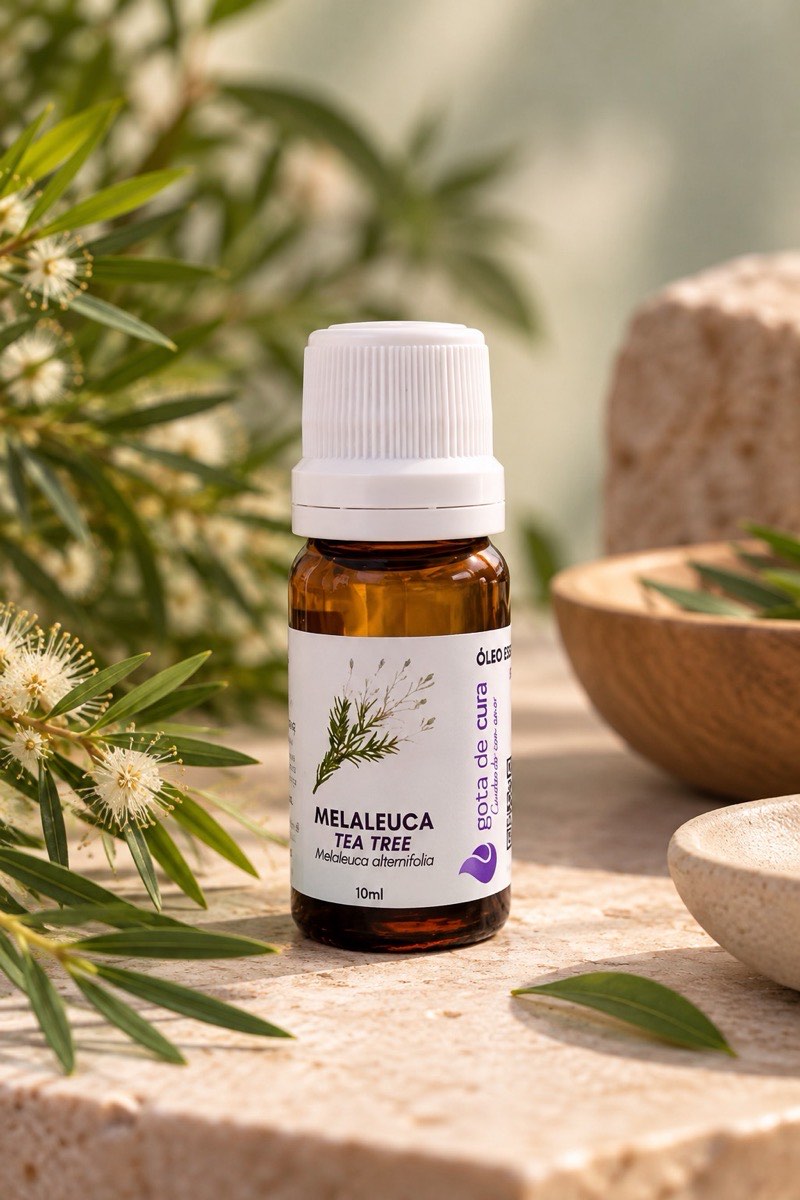 A 10 ml amber bottle of Gota de Cura tea tree essential oil on a pale stone, among tea tree branches and flowers
Always with dilution in mind:
- Acne and individual pimples. Diluted in a vegetable oil or gel at up to 5%, applied with a cotton swab only to the spot.
- Skin in general, on the body. Dilutions of 1% to 2% in a vegetable oil (about 1 to 2 drops per 5 ml).
- Scalp and dandruff. A few drops mixed into your portion of shampoo at wash time, to get close to the 5% used in the studies, rinsing well.
- Feet and nails. Diluted in a vegetable oil, after washing and drying the feet well, as support in caring for athlete's foot.
- Diffuser. 3 to 5 drops in the diffuser water, for 20 to 30 minutes, to purify the air and ease breathing during flu and colds.
- Dry inhalation. One or two drops on a tissue, to breathe in when your nose is congested.
How to use the hydrosol
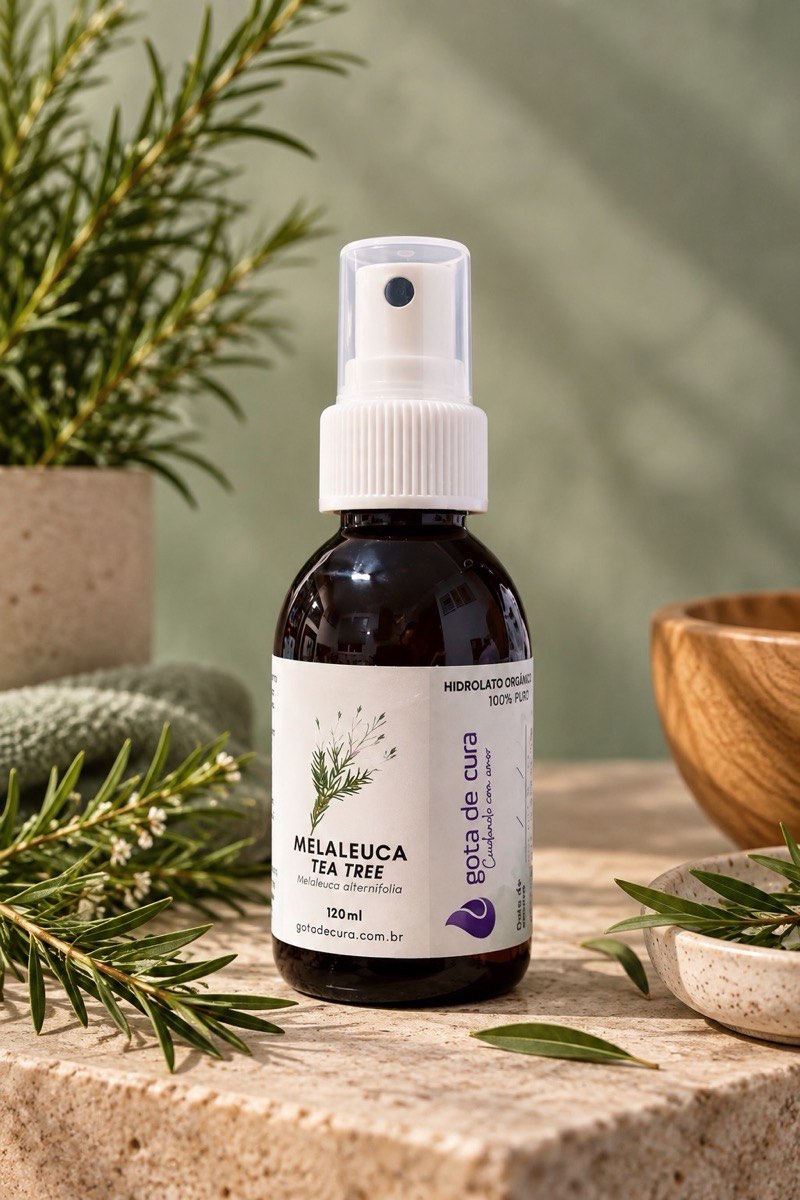 A 120 ml amber bottle of Gota de Cura tea tree hydrosol with a spray valve, among flowering tea tree branches
Tea tree hydrosol can be used as is, undiluted:
- Facial toner for oily and acne-prone skin. Sprayed after cleansing, morning and night, or applied with a cotton pad.
- Mild skin breakouts and irritation, such as after shaving or waxing, sprayed on the area.
- Scalp with dandruff or oiliness, sprayed on the roots after washing, with a massage.
- Feet, sprayed after a shower and before putting on shoes, as daily care for those prone to athlete's foot and foot odor.
- Breathing, in an ultrasonic diffuser or humidifier, as support for coughs, bronchitis, asthma and sinusitis. For people with asthma, do a short test first, because any aroma can trigger an attack in someone sensitive.
- Room and intention, sprayed into the space or around the body, in the moments of renewal described above.
For children, older adults and during pregnancy and breastfeeding, the hydrosol is usually the safer of the two, as we explain in hydrosols for babies, pregnancy and older adults.
Safety precautions
- Do not swallow the essential oil. Ingesting tea tree oil has caused confusion, loss of balance and even coma, especially in children. Keep it out of their reach.
- Do not use it undiluted on the skin unless a professional advises it. And avoid the eyes, ears and mucous membranes.
- Do a patch test before first use: a little of the dilution on the inside of the forearm, waiting 24 hours.
- Store it carefully. Tea tree oil oxidizes on contact with air, light and heat, and oxidized oil is much more likely to cause skin allergies. Keep the bottle tightly closed in a cool, dark place, and preferably use it within a year of opening. If the smell changes, throw it away.
- Pets. Tea tree oil is toxic to cats and dogs, even on the skin. Don't apply it to animals, and be careful with a diffuser in a closed room where they spend time.
- The hydrosol is water, and it spoils. Keep it in the fridge, use a bottle with a spray valve and throw it away if it turns cloudy or its smell changes.
This article doesn't replace an individual assessment. If in doubt, always consult a qualified professional, especially if you are pregnant or breastfeeding, are thinking of using it on young children or have a diagnosed health condition. Tea tree does not replace antibiotics, antifungals or any prescribed treatment.
Sources
- Carson, C. F.; Hammer, K. A.; Riley, T. V. Melaleuca alternifolia (Tea Tree) Oil: a Review of Antimicrobial and Other Medicinal Properties. Clinical Microbiology Reviews, 2006.
- National Center for Complementary and Integrative Health (NCCIH). Tea Tree Oil.
- Encyclopaedia Britannica. Tea tree oil.
- Gota de Cura. Chromatography report for Melaleuca alternifolia essential oil (GC-MS).
- Gota de Cura. Melaleuca: renovação e desprendimento (video, in Portuguese).


