

People who come to the shop to buy an essential oil "to help the baby sleep" or "for morning sickness" almost always hear the same answer, and it usually disappoints: in these cases, the most prudent path is rarely undiluted essential oil. Not because aromatherapy and pregnancy don't go together, but because essential oil is a concentrated product, and concentration calls for care. That is where hydrosol stops being a supporting player and becomes the first choice.
Why essential oil calls for caution in some cases
A small bottle of essential oil represents kilos of plant (we explained that math here). That is the product's strength and also the reason for care: the active compounds are all there, packed tightly together. In four situations the margin for error gets smaller.
Babies and young children. A baby's respiratory system is still developing, and some compounds common in essential oils, such as those in eucalyptus and mint, can trigger a respiratory reaction in very young children even in small amounts. A baby's skin is also thinner and absorbs more. Undiluted essential oil never goes on anyone's skin, and on a child's skin not even diluted without guidance.
Pregnancy and breastfeeding. Many aromatic compounds cross the placenta and pass into breast milk. Some oils are advised against during pregnancy, especially in the first trimester, and for many others there simply aren't enough studies — which in practice leads to the same place: better not to take the risk on your own.
Older adults. Thinner, drier skin absorbs differently, the sense of smell changes, and ongoing medication is common. Essential oil can interact with anticoagulants, blood pressure medication and other daily medicines, and that conversation needs to go through whoever prescribes them.
Sensitive, reactive or dermatitis-prone skin. A poorly diluted essential oil irritates and, worse, can sensitize the skin for good: once the body reacts to a compound, it tends to react to it every time.
In none of these cases is essential oil forbidden. What changes is that a professional's guidance stops being an extra and becomes part of the process.
Where hydrosol changes the math
 A woman spraying hydrosol over bed linen in a room with morning light, the fine mist visible against the window
In distillation, the plant yields two products at the same time. The essential oil carries the compounds that dissolve in oil; the hydrosol carries those that dissolve in water. Same origin, same still, same plant, in two different fractions.
The difference that matters here is concentration. Hydrosol is aromatic water: the compounds are present in much smaller amounts, and the pH is close to the skin's. That's why it can be used directly, undiluted, in most cases, and why it is usually considered the appropriate form of aromatherapy precisely when essential oil calls for stepping back.
In fairness, it's worth noting: saying that hydrosol has "no known contraindications" describes the most common topical and room uses. It doesn't mean it is harmless in every situation, and it also reflects the fact that there is less research on hydrosols than on essential oils.
Case by case
Babies and children
- In the room: spray the bedroom before the child comes in, or on bed linen that has already been aired. Don't spray the face, the hands or the pillow the baby is about to lie on.
- A warm compress for localized discomfort, with a clean, well-wrung cloth.
- Under 6 months: only with the pediatrician's guidance, and even then only occasionally.
- Hydrosols of gentle plants, such as chamomile and lavender, are the most used at this stage.
Pregnancy and breastfeeding
- Spray on the face after cleansing, in the room, or use in a compress or foot soak.
- Avoid internal use (gargling, cooking, mouth rinse) on your own during pregnancy and breastfeeding.
- In the first trimester, the most prudent course is to check with your obstetrician before introducing anything new, hydrosol included.
Older adults
- Facial toner, light hydration before cream, a compress for tired eyes, a refreshing spray on hot days.
- Unlike essential oil, hydrosol doesn't usually compete with daily medication.
- Thinner skin still needs attention: watch the area for the first few days and stop if redness or dryness appears.
Sensitive, reactive or dermatitis-prone skin
- Do a test first: spray on your forearm and wait 24 hours before using it on your face.
- Use it as a toner right after cleansing, while the skin is still damp.
- Stinging, itching or redness are a sign to stop. Gentle doesn't mean it suits every skin.
How to use it safely all the same
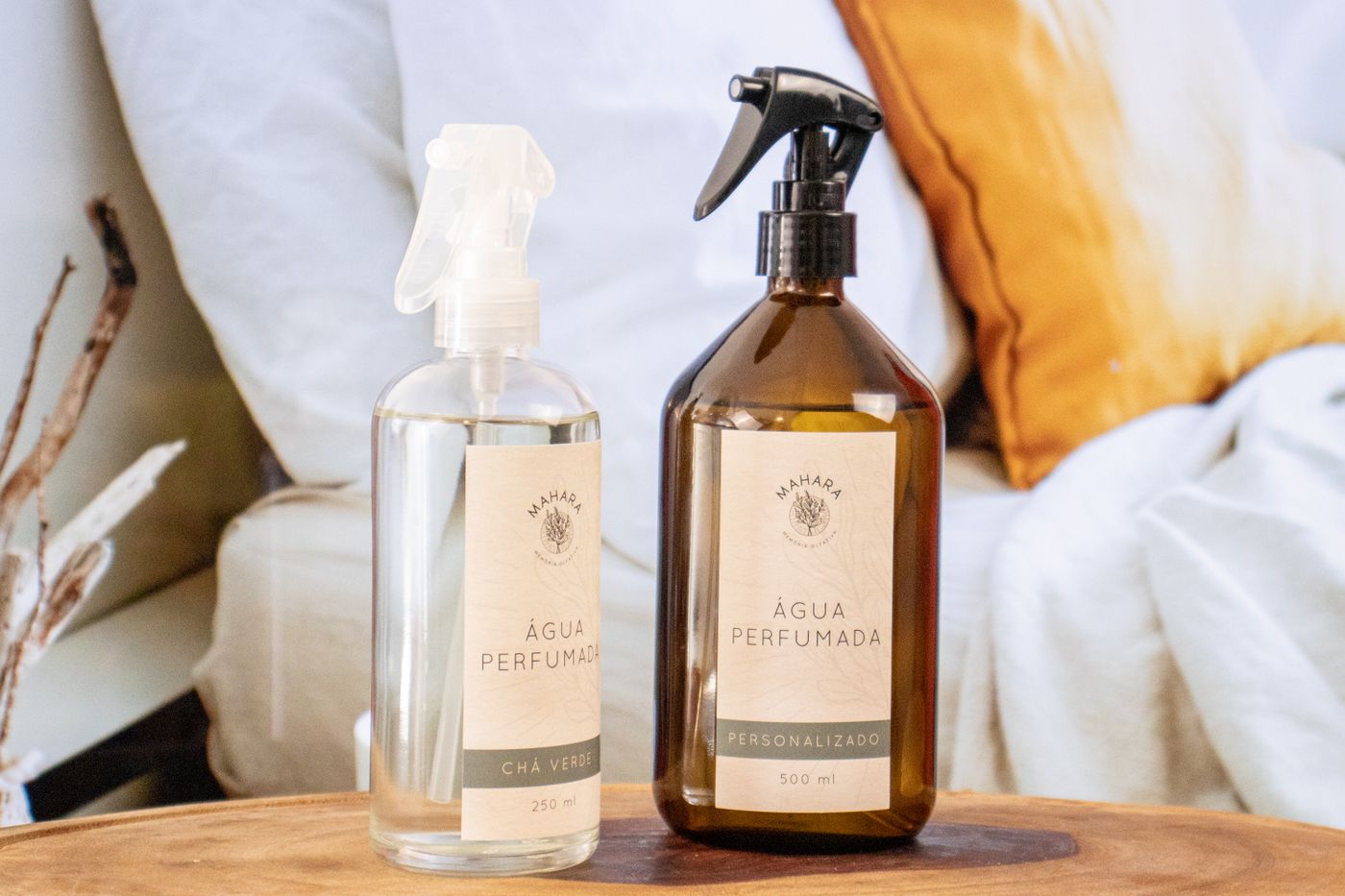 Two bottles of aromatic water with spray valves, one in amber glass and one in clear glass, on a wooden table
Hydrosol needs a kind of care essential oil hardly needs at all: it is water, and water spoils. Without the preservatives of an industrial cosmetic, a hydrosol can become contaminated over time, especially with heat, light and repeated contact with hands.
- Always choose a bottle with a spray valve and avoid touching the nozzle to your skin or fingers.
- Keep it in the fridge and away from light. The stable temperature avoids the swings that speed up contamination.
- If you notice a change in color, a different smell or a cloudy look, throw it away. When in doubt, throw it away.
- Internal use (gargling, mouth rinse, cooking) only makes sense with a hydrosol whose source water you know, and it is not recommended on your own for pregnant people or children.
- Keep it away from the eyes and mucous membranes, gentle as it is.
- When introducing it, use one product at a time for a few days, so you can tell where any reaction came from.
What hydrosol is not
Hydrosol is not medicine. It doesn't treat disease, doesn't stop a crisis and doesn't replace an appointment with the pediatrician, obstetrician or geriatrician. What it does well is become part of a care routine (sleep, skin, freshness, the moment of pausing to breathe) without carrying the risk that the concentration of essential oil brings to these groups.
As with essential oil, the logic of "it's natural, so it can't hurt" doesn't apply here either. The difference is one of proportion, not of nature. That's why we publish the lab test for every plant we distill on the lab reports page: the only honest way to say what is in a bottle is to show the analysis.
When hydrosol complements a treatment
"It isn't medicine" doesn't mean "it has no place in a treatment". Some hydrosols, always under a professional's supervision, are used as a complement (never a replacement) to a treatment that is already under way.
The best-known example is jambolan hydrosol, associated with diabetes management. Jambolan (Java plum) is one of the most studied plants for its effect on blood sugar: there are several studies on the seed, the leaf and the fruit, most of them still in the lab and in animals, a few in people. Hydrosol is a much more dilute fraction than those extracts, so it serves as support for the routine of people already treating the disease, alongside their medication and medical guidance.
The key word is supervision. A plant that acts on blood glucose can also affect the dose of the medicine someone already takes, and the one who adjusts, monitors and decides whether it makes sense is the professional caring for the case. On your own, the risk of hypoglycemia or of losing control of the disease is real. The same goes for any hydrosol used with therapeutic intent, and not just as skin or room care.
This article doesn't replace an individual assessment. If in doubt, always consult a qualified professional before you start, especially if you are pregnant or breastfeeding, are thinking of using it on a baby under 6 months, or care for someone on ongoing medication.


