

Anyone cutting a blood orange for the first time tends to step back. On the outside it looks like an ordinary orange, sometimes with a reddish blush on the peel. Inside, the flesh runs from pink to wine, as if someone had painted the fruit. The smell, though, is pure orange: sweet, fresh, with a slightly fruity undertone. This text tells where it comes from, why it has that color and how to use the hydrosol safely.
What the blood orange is
The blood orange is the same species as the sweet orange we all know: Citrus sinensis, in the rue family (Rutaceae), home to lemons, mandarins, grapefruit and bergamot. It is not a separate species, but a group of sweet orange varieties that accumulate a red pigment in the flesh and, sometimes, in the peel.
The sweet orange itself is ancient, a natural cross between the mandarin and the pomelo that happened in southern China and neighboring regions. From there it followed trade routes to the Mediterranean, and Portuguese sailors played a big part in spreading it around the world, Brazil included.
Where the color comes from
The red comes from anthocyanins, water-soluble pigments that color blueberries, blackberries, red grapes and red cabbage. Common oranges do not make them. Blood oranges do, because of a natural genetic mutation: researchers at the John Innes Centre in the UK showed in 2012 that a mobile piece of DNA (a retrotransposon) settled next to a gene called Ruby, which controls the production of these pigments.
The curious part is that this switch only turns on with cold. Without cool nights during ripening, the gene stays quiet and the flesh comes out orange, almost like a regular orange. That is why the blood orange is tied to so few places in the world.
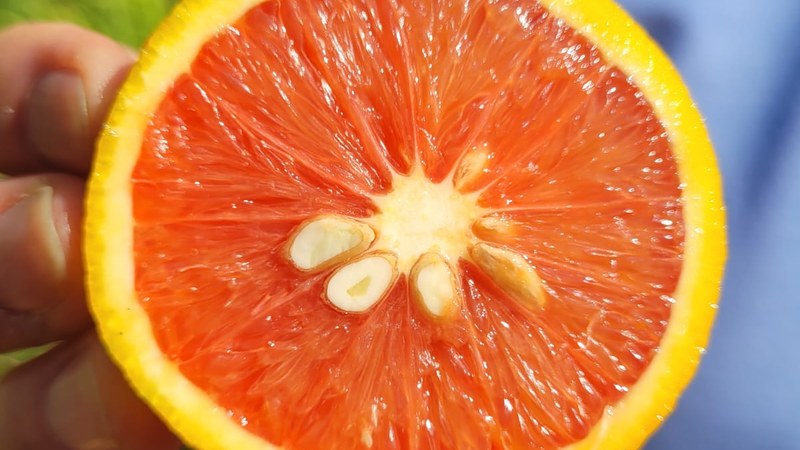 Blood orange from the farm cut in half, held in a visitor's hand, with red-orange flesh and the seeds showing
This is one of the blood oranges from our farm, cut open during a visit in August. The color varies from fruit to fruit and from season to season, precisely because it depends on the cold.
Origin: Sicily and Mount Etna
The blood orange most people talk about was born in Sicily, Italy, and the area around Mount Etna is still the main producing region: warm days and cold nights on volcanic soil are exactly what the Ruby gene asks for. Italians sometimes call it the island's "red gold".
When the mutation first appeared is an open question. Some link the fruit to the Arab period in Sicily, from the 9th century on, but that date comes more from popular writing than primary sources, and the safest records are much later. What the genetic studies point to is that the color arose more than once, in different places: the Sicilian origin, another linked to Spain, and a third in China.
The three best-known varieties are:
- Tarocco. The Sicilian favorite, sweet, low in acidity, with flesh streaked in red.
- Moro. The darkest, with deep wine-colored flesh and a bolder flavor that hints at red berries.
- Sanguinello. Of Spanish origin, with a redder peel and flesh marked with color.
Outside Sicily it grows in places like Spain, the United States, Japan, South Africa and Iran, but the color does not show up every year. In climates that are too warm, the fruit can ripen without pigmenting.
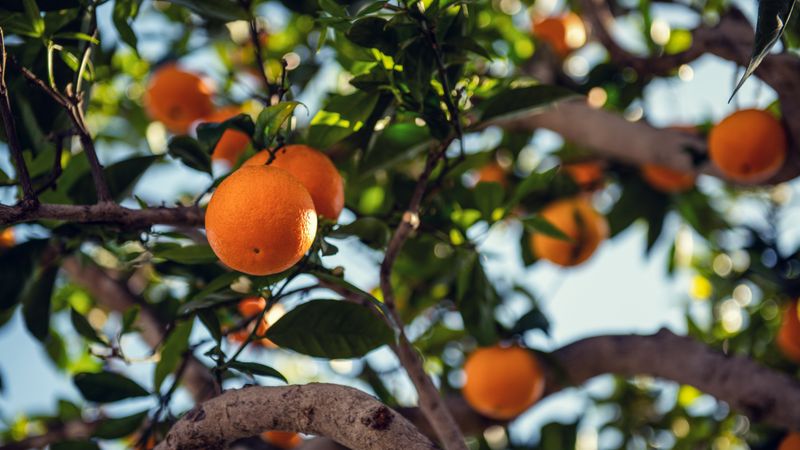 Orange orchard with ripe fruit among green leaves
The plant and the fruit
The orange tree is small to medium in size, with glossy dark green leaves and very fragrant white flowers, the orange blossoms that give rise to another well-known scent. The fruit is rich in vitamin C and, in the blood orange, also carries anthocyanins, antioxidants studied in the lab. A word of honesty, as always: eating the fruit is one thing, using the hydrosol is another. The benefits of the flesh do not automatically carry over into the bottle.
Blood orange hydrosol
Distillation gives two products at once. The essential oil carries the fat-soluble substances, and the hydrosol carries the water-soluble ones, in a lighter, gentler profile, with the plant's fresh citrus character and little of the oil's concentration. We explain the difference in more detail in essential oil or hydrosol, what is the difference.
What is attributed to blood orange hydrosol comes mostly from the traditional use of citrus and from the experience of people who use it. There are no clinical studies specifically on the hydrosol of this variety.
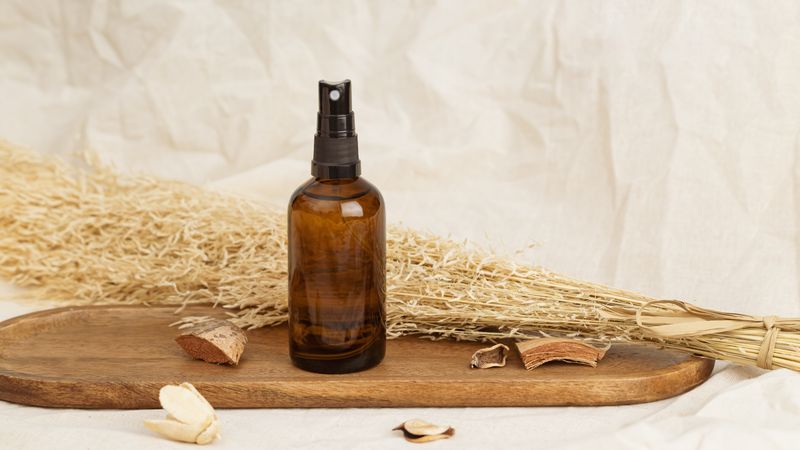 Amber glass spray bottle on a wooden tray next to dried plants
For body and mind
- Invigorating. The citrus scent is associated with a feeling of energy and alertness. A mist on the face or in the air, in the morning or on a tired afternoon, tends to be welcome.
- Calming. At the same time, the sweet orange scent is traditionally tied to relaxation. In aromatherapy, citrus shows up both to lift and to calm, and the response varies from person to person. For why a smell moves emotion, see aromatherapy and the limbic system.
For the skin
- Facial toner. Gentle enough to mist on the face after cleansing, to refresh and prepare the skin for moisturizer. Suitable for most skin types, but test a small area first.
- Cleansing and freshness. By traditional use it is considered mildly antiseptic, handy for refreshing the skin. That does not make it a treatment for infection or acne.
- Light deodorant. Misted on the underarms after a shower, it helps keep the skin fresh and scented. It is not an antiperspirant: it perfumes and refreshes, it does not stop sweat.
For digestion
Some people take the hydrosol diluted in water after meals, following the traditional use of citrus. Caution applies here: internal use of hydrosol only with water of known origin and professional guidance. It is not something we recommend on your own.
For your space
Misted into the air, on bed linen or in the car, or in an ultrasonic diffuser, it is a simple way to bring the scent of orange into everyday life.
The essential oil: already diluted and ready to use
We also offer blood orange essential oil (Citrus sinensis) in a ready-diluted version: blood orange essential oil (2% dilution in MCT), 5 ml bottle. That is two drops of essential oil for every 5 ml of MCT, medium-chain triglyceride, a light fractionated vegetable oil with almost no scent. You do not have to do the math or count drops: the dilution is already done. To understand how and why we dilute, see our page on essential oil dilutions.
A 2% dilution is commonly suggested for use on the body, in massage and for localized application. Even so, do a patch test first, keep it away from eyes, ears and mucous membranes, and remember that citrus essential oil can make skin more sensitive to the sun: avoid sun exposure right after applying it. Essential oil must never be ingested.
Safety precautions
- It is water, and it spoils. Keep it in the fridge, in a bottle with a spray valve (so you do not wet your finger), away from light, and discard if it turns cloudy or the smell changes.
- Do a patch test on a small area of skin before first use and wait a few hours, especially if you are allergic to citrus.
- Avoid eyes, ears and mucous membranes.
- Citrus essential oil needs more care than the hydrosol: always diluted, never ingested, and watch for photosensitivity, because some citrus oils can stain skin exposed to the sun.
- Pets. Citrus scents can bother cats and dogs. Be careful with diffusers and sprays in closed rooms where they stay.
This text does not replace an individual assessment. If in doubt, always consult a professional, especially if you are pregnant, breastfeeding, thinking of using it with small children or have a diagnosed health condition. Hydrosol does not replace prescribed treatment. Lab reports for each batch are on our chromatography page: what is on the label is what is in the bottle.
Sources
- Butelli, E. et al. Retrotransposons control fruit-specific, cold-dependent accumulation of anthocyanins in blood oranges. The Plant Cell, 2012.
- John Innes Centre. Blood Oranges.
- Gota de Cura. Essential oil or hydrosol, what is the difference.


