

Anyone who works with aromas learns early to recognize a particular reaction: a person opens the bottle, breathes in, and before saying a word their face changes. Only then comes the sentence: "this reminds me of my grandmother's house", "I don't know why, but I feel relaxed".
That order is neither chance nor suggestion. It is how the body works.
The short path smell takes
The other senses make a stop along the way. When you see, hear, touch or taste something, the signal first goes through a kind of sorting center in the brain, which organizes the information before sending it on. That is why seeing something and recognizing what it is happen almost at the same time: the signal arrives already organized.
Smell doesn't do that.
A scent enters through the nose and is picked up by receptors high up in the nasal cavity. From there, the signal goes straight to two parts of the brain: the one that gives emotional weight to what you are feeling, and the one that stores and retrieves memories. No stopover, no sorting center along the way.
This matters because neither of those parts is there to recognize what the scent is. One decides whether it seems good or bad before any analysis; the other stores memories and brings them back. The aroma reaches both before you even think "this is lavender".
There is also a longer path inside the brain, the one that lets you consciously identify and name the scent. But that path arrives later. The emotional reaction has already happened.
Why memory comes along
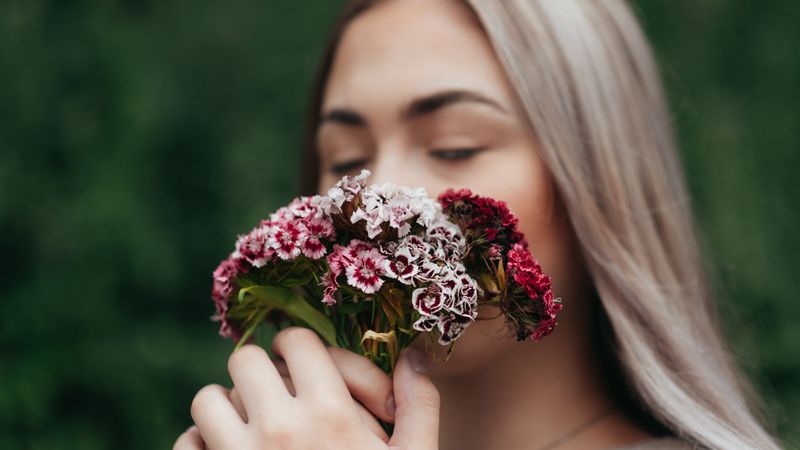 A woman with her eyes closed bringing her face close to flowers to smell them, surrounded by green foliage
This effect even has a name, borrowed from literature: the Proust phenomenon, after a famous scene in In Search of Lost Time in which the smell and taste of a small cake bring back a whole childhood memory.
What research on memory shows is this: memories triggered by a scent are not necessarily more numerous or more accurate than those triggered by a word or a photo. But people describe them as more emotional, more vivid, and with a stronger feeling of "being back" in that moment.
That makes sense, given the path a scent travels. A memory that comes in through the door of emotion arrives already marked by it.
In practice this has a consequence worth knowing: the response to an aroma is individual and learned. An oil that calms most people can unsettle someone who associates it with a hospital. There is no universally relaxing aroma, and be wary of anyone who claims otherwise.
What science confirms, and what it doesn't
This is where the conversation usually goes off the rails, one way or the other. Either aromatherapy cures everything, or it's scented placebo. It's neither.
| Effect | What the research shows |
|---|---|
| Anxiety in specific moments (before surgery, at the dentist, during exams) | Several studies show a real, if small, reduction. |
| Sleep quality | Improvement reported when inhaling lavender before bed, but in small studies based on what people themselves say they feel. |
| Nausea | Good evidence for smelling peppermint or ginger, including after surgery. |
| Pain | Results vary a lot. When it helps, it helps a little, and always alongside pain medication, never instead of it. |
| Everyday mood and stress | The body shows real signs of relaxation, but it is hard to know how much comes from the oil and how much from the habit of stopping to breathe. |
| Curing disease, replacing medication | No evidence. That is not what aromatherapy does. |
All of this research has an honest limitation: it is almost impossible to hide from study participants that they are smelling something. They know. That means part of the result may come from their expectations, and it's good to keep that in mind when reading the numbers.
But "part of the effect comes from expectation" is not the same as "the effect doesn't exist". A person who slept better did sleep better.
Whole-person health is not a slogan
The expression has become marketing, so it's worth recovering what it means.
Whole-person health is the idea that sleep, mood, stress, appetite and energy are not separate from health: they are health. Sleeping badly or living under stress has a real effect on blood pressure, immunity, blood sugar and the body's recovery. Treating that as secondary is the real mistake.
That is where aromatherapy comes in. Not as a treatment for disease, but as a low-cost, low-risk practice that works exactly where it can reach: the state in which you get through the day.
And there's something the people in our shop learn faster than those who only read the studies: using it every day is worth more than using a lot of it once. Five minutes of inhalation a day does more than an elaborate session once a month. Part of what works is the very act of pausing for a moment: the oil is the excuse to take a deep breath, and stopping to breathe is, in itself, part of the care.
Four ways to start
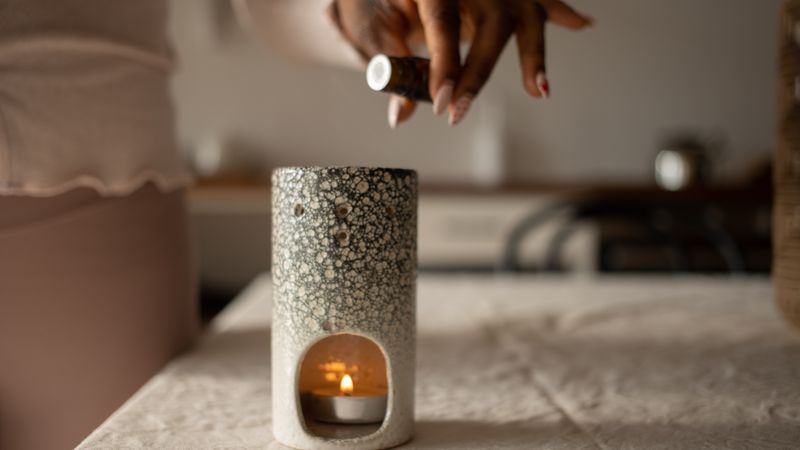 A hand dropping essential oil into a diffuser on a table, next to a lit candle
Room diffusion. Water and a few drops, 20 to 30 minutes, in a ventilated room. A diffuser running all day doesn't increase the effect — it just tires your nose, and you stop noticing the scent.
Dry inhalation. One or two drops on a cotton ball, a tissue or a personal inhaler. It's the most direct form and the easiest to control, and the one that suits anxiety in specific moments, because it fits in your pocket.
Diluted body oil. Essential oil always diluted in a vegetable oil, never undiluted on the skin. An easy rule to remember: one drop of essential oil for every 5 ml of vegetable oil makes roughly 1%. On the body, adults tolerate 2% to 3%; on the face, 1% is better; for children, during pregnancy or on sensitive skin, use even less.
Bath or bath salts. Essential oil doesn't mix with water. Always add it to bath salts or another product that helps disperse it, and never drop it straight into the tub: it floats, concentrated, on the surface, in direct contact with your skin.
An important warning: citrus oils make the skin more sensitive to the sun for up to 12 hours. Bergamot, lemon and orange used on an area that will be in the sun can stain the skin, even when diluted correctly.
Where aromatherapy doesn't belong
If you have a diagnosed condition, are pregnant or breastfeeding, take ongoing medication, or plan to use it on a young child, the decision shouldn't come from an article — not even this one. Several oils are not recommended in these cases, and some interact with medicines.
Aromatherapy is a complement. It does not replace a consultation, tests or treatment, and anyone who tells you otherwise is offering you risk packaged as care.
What we can guarantee is the other part: what is written on the label is what is inside the bottle. The lab results for each plant (what is called chromatography) are published on the lab reports page, because a pleasant smell doesn't prove what's in the composition, and the only honest way to prove what a label promises is to show the test.
Nothing here replaces an individual assessment: if in doubt, always consult a qualified professional before starting any use.


