

Visitors to our distillery tend to spend a good while watching the essential oil appear drop by drop, and almost always someone asks: "and that water coming out with it, what is it for?" It is for a lot of things. In an excellent-yield distillation, 60 kg of plant gives about 500 ml of essential oil and about 8 liters of hydrosol: two results of the same distillation, the oil carrying what the plant has that is fat-soluble and the hydrosol carrying what is water-soluble. We have already explained that difference in essential oil or hydrosol: what is the difference. This text is the other side of the coin: what to do with the bottle once it gets home.
There are more than twenty uses, and here they are organized by situation, so you can quickly find what you are looking for.
The basics, before any use
A hydrosol is aromatic water, much gentler than an essential oil, so most uses are simple: pure, undiluted and not mixed with oil. Water and oil do not blend, so the hydrosol takes the place of the water, not of the oil. Three habits apply to everything below:
- A spray bottle, so you never dip a finger in the liquid or carry germs into it.
- The fridge, because a hydrosol is aromatic water and spoils like any water. As a bonus you get a refreshing effect, great in a warm climate.
- A patch test before the first use: one spray on the forearm and a 24-hour wait, especially if your skin is sensitive.
On the face
 A woman spraying a facial mist in front of a large window with her eyes closed, in a moment of skin care
This is where most people start, and for good reason: the pH of a hydrosol is close to that of the skin, and it is usually well received by every skin type, from oily to dry.
- Toner after cleansing. Spray it on your face or apply it with cotton, morning and night, before moisturizer.
- Compress for tired eyes. A cotton pad or a clean cloth dampened with cold hydrosol, over closed eyelids for a few minutes.
- Ice cubes. Freeze the hydrosol in an ice tray and run a cube over your face in the morning to wake the skin up. Wrap the cube in a thin cloth if your skin is sensitive.
- Facial steaming. One tablespoon of hydrosol in a bowl of hot water, face at a comfortable distance and a towel over your head, for 5 to 10 minutes. Watch out for the steam so you do not get burned, and skip it if your skin is very reactive or you have asthma attacks.
- Clay mask. Instead of water, mix the clay with hydrosol into a cream, apply it and rinse it off when the clay starts to tighten.
- Aftershave. Sprayed on freshly shaved skin, it cools and soothes.
If your skin is oily, tea tree hydrosol is a good starting point. Every plant has its own personality, and what matters is choosing the scent you enjoy having on your face.
On the body
- Sitz baths, foot soaks and the bathtub. A few sprays or a cup of hydrosol in warm water turn a bath into a moment of pause. In a foot soak, 10 to 15 minutes make a difference after a day on your feet.
- Before a massage. Spray the skin and then apply the massage's carrier oil, or use the hydrosol to refresh the area at the end.
- Homemade creams and lotions. The hydrosol can take the place of the water in the recipe. But beware: without a proper preservative, the product lasts only a few days in the fridge. Make small batches.
- Light perfume base. A body spray made only of hydrosol, or a blend of hydrosols, is a soft, discreet perfume without the concentration of an essential oil.
On the hair
- Scalp. Sprayed on the roots after washing, with a massage, it is a refreshing tonic. Tea tree and rosemary are among the most used for this.
- Finishing mist. Spray it on damp strands before combing or drying, to scent them and help detangle.
At home
 A made bed with white sheets and pillows in a bright, cozy bedroom
Room spray is one of the favorite uses for people who keep hydrosols at home, because it scents the air without the intensity of an essential oil diffuser.
- Room spray. Living room, office, bathroom, car. Lavender is a classic for winding down, and fresher ones, like rosemary, go well with the morning.
- Bed linen. One spritz on the sheets and pillow, from about 30 cm away, 10 minutes before bed.
- Towel in the dryer. Spray a damp towel with hydrosol and toss it in the dryer with your clothes. They come out lightly scented.
- Humidifier or ultrasonic diffuser. Follow the manufacturer's instructions and use only a little hydrosol at a time. Our usual rule applies here: if you have asthma or rhinitis, test one scent at a time.
Small everyday care
Here the hydrosol comes in as comfort and cleaning, in a traditional and well-established use, with no promise of a cure.
- Scrapes and small cuts. Wash first with soap and water. Then the hydrosol can be sprayed on or applied with clean gauze to refresh the area.
- Insect bites. Cold, it helps ease itching and redness.
- Compress on skin irritated by sun or wind. A clean cloth soaked in cold hydrosol, for a few minutes.
A deep wound that will not stop bleeding, swells, heats up, oozes or does not improve in a few days is a matter for healthcare. A hydrosol is no substitute for treatment.
In the mouth and in the kitchen
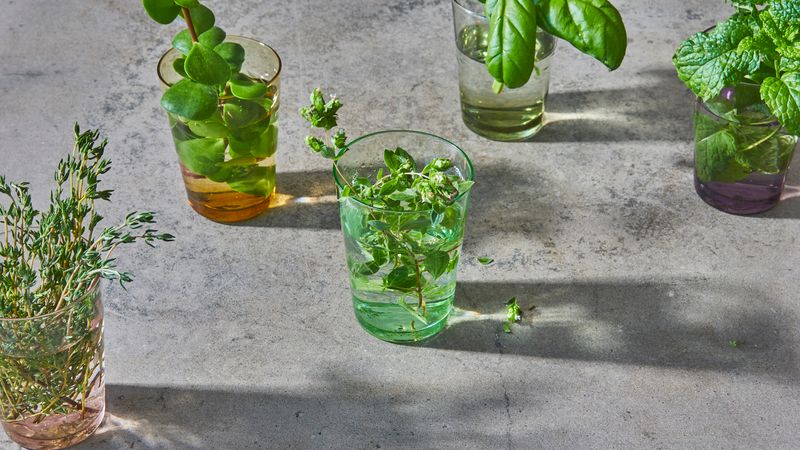 Fresh herb leaves in glass cups on a light surface, lit by daylight
Some hydrosols have been used for centuries in cooking, in sweets and drinks, as with orange blossom water and rose water in traditional recipes all over the world. Some people also use hydrosol as a mouthwash and for gargling. This is the group of uses that calls for the most care:
- Ask the producer whether that hydrosol is suitable for consumption. Not all are.
- Use water of known origin when diluting, because a hydrosol does not sterilize anything: if the water is poor, the result will be too.
- Start with a small amount and do not use it on your own if you are pregnant, breastfeeding, take ongoing medication or have a diagnosed health condition. Talk to a professional first.
How to store it (and when to discard it)
Everything above only works if the hydrosol is in good condition. Keep it in the fridge, away from light, tightly closed, and watch for three signs: cloudy water, a sour smell or one different from the original, and floating particles. If any of them shows up, discard it. A slight change in aroma over time may be maturing, but when in doubt the best path is to throw it out.
Limited only by imagination
Aromatherapist Ann Harman sums the subject up in one sentence: "When we use hydrosols, we are limited only by our imagination." The list above is a starting point, not a limit. Try one use at a time, notice how your skin and your home respond and, if in doubt, ask. When you want to see how a hydrosol is born, we welcome visits at the farm: find out how on the visits page.
To meet the hydrosols we distill, stop by the hydrosols page. In every one of our batches, what is on the label is what is in the bottle, and you can check it in the chromatography reports.
This text does not replace an individual assessment. If in doubt, always consult a professional, especially if you are pregnant, breastfeeding, thinking of using it on small children or have a diagnosed health condition.


